
Stop Vibrating, Start Flowing: Why Use a PCE Superplasticiser in GRC?
The Evolution of GRC Casting
Traditionally, achieving high-strength concrete required a strict trade-off. To make concrete stronger and more durable, mix designs required minimising the water-to-cement ratio. However, reducing water results in a stiff, unworkable mix. To force this unyielding material into complex moulds or around tight reinforcement matrices, manufacturers have historically relied heavily on mechanical compaction and intense vibration.
Advancements in chemical admixture technology have fundamentally rewritten this rule. One of the most significant leaps forward was the development of Polycarboxylate Ether (PCE) technology, commonly known as high-range water reducers or superplasticisers.
When applied to Glassfibre Reinforced Concrete (GRC), this technology enables the creation of a specialised composite: Self-Compacting GRC. This advancement marks a major improvement in how complex architectural elements are cast, shifting the industry away from brute-force mechanical compaction toward advanced fluid dynamics.
What is a PCE Superplasticiser?
To understand how a PCE superplasticiser works, you have to look at how cement behaves when mixed with water. Naturally, dry cement particles carry mixed electrical charges. When water is added, these particles instantly attract one another and clump together (flocculation). This clumping traps a massive amount of the mix water inside the cement clusters, leaving less water available to lubricate the mix and make it flow.
Older generations of plasticisers (like lignosulphonates or melamine) worked purely by giving the cement particles a uniform negative charge, causing them to repel one another and release that trapped water.
Modern PCE superplasticisers take this science a step further by using steric hindrance.
The long, polymer “side-chains” of the polycarboxylate molecule attach to the cement grains like protective bristles. These chains physically push the cement particles apart, preventing them from clumping. This dual-action mechanism – electrostatic repulsion combined with physical steric hindrance – allows for a massive water reduction of up to 40% by transforming a stiff mix into an incredibly fluid, self-levelling mix.
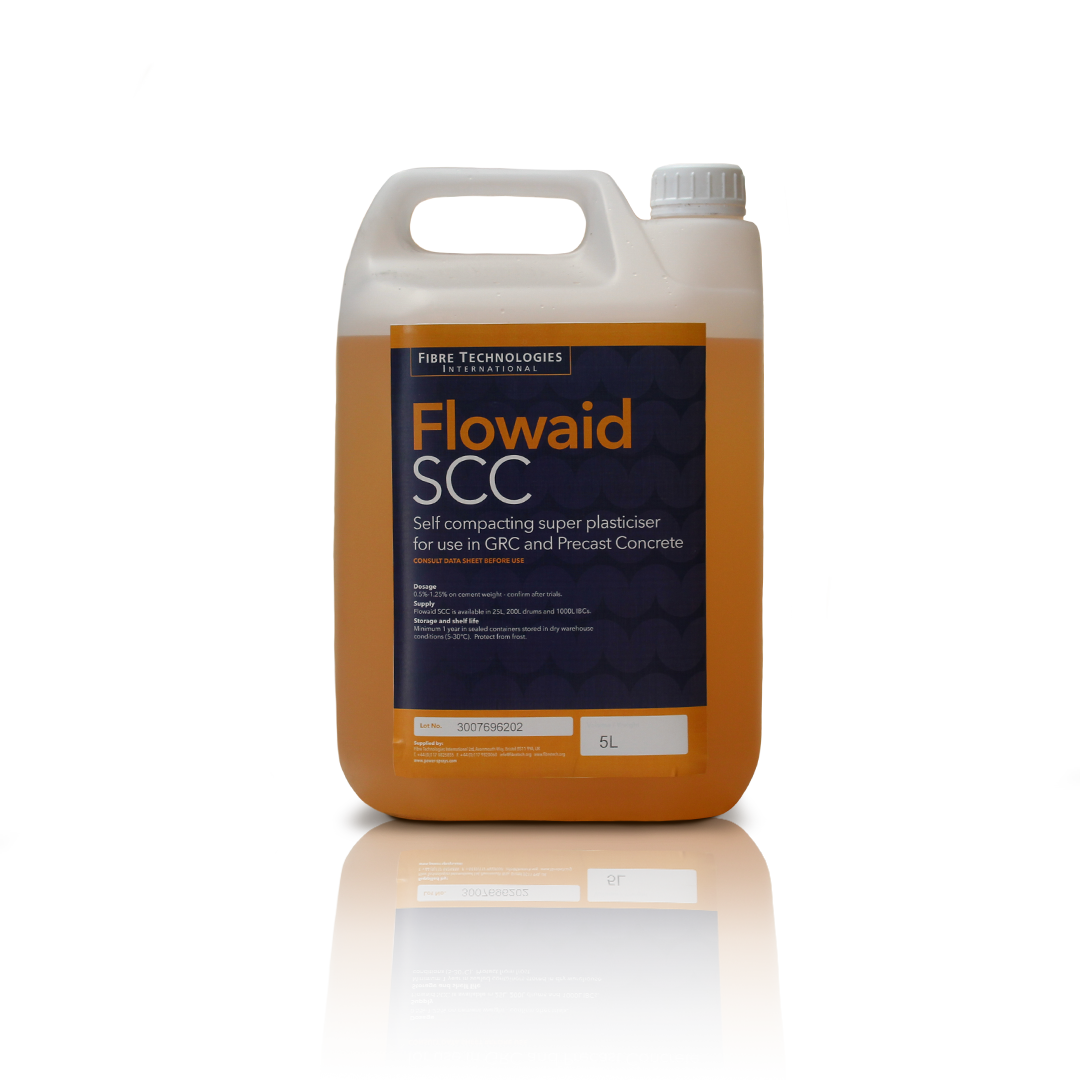
Flowaid SCC applies this advanced PCE technology but has been specifically formulated to perform with the high cement content typically found in GRC, helping to deliver excellent workability while maintaining mix stability.
The Benefits of Self-Compacting GRC
Aside from achieving extreme fluidity without sacrificing the water-to-cement ratio, incorporating a premium casting superplasticiser into a GRC mix delivers several transformative operational benefits:
Eliminates Manual and Mechanical Vibration
In a traditional precast setup, workers must use vibrating tables, poker vibrators, or manual screeding to force air pockets out of the mould. Self-compacting GRC completely eliminates this step. Because the mix behaves like a true liquid, it consolidates purely under its own gravitational weight. It flows effortlessly into the sharpest corners and most intricate details of a mould, completely unassisted.
By significantly reducing the need for prolonged use of vibrating equipment, self-compacting GRC can also help reduce operators’ exposure to hand-arm vibration, lowering the risk of vibration-related conditions such as Hand-Arm Vibration Syndrome (HAVS), commonly known as Vibration White Finger (VWF).
Prevents Segregation and Bleeding
A common risk when making a concrete mix highly fluid is segregation – where heavy aggregates sink to the bottom and water rises to the top, ruining the structural integrity of the cast. Advanced casting superplasticisers feature integral stability agents. This ensures that even at maximum fluidity, the cement particles, sand, and glass fibres remain perfectly and uniformly suspended throughout the matrix.
Delivers Void-Free, Flawless Finishes
Mechanical vibration often leaves behind unsightly surface blemishes, bug holes, or honeycombing where air remained trapped against the face of the mould. Because an SCC mix flows like water, it displaces air naturally as it fills the mould from the bottom up. The result is a flawless, glass-smooth architectural finish straight out of the form, dramatically reducing or entirely eliminating the time your factory team spends on post-pour patching and cosmetic repairs.
Protects and Extends Mould Lifespan
Constant, high-frequency mechanical vibration subjects expensive timber, fiberglass, or silicone moulds to immense physical fatigue. Over time, joints split, details warp, and moulds must be discarded prematurely. By transitioning to a self-levelling pour, the physical stress on your tooling is virtually zeroed out, lowering your long-term tooling costs.
Got a Question About GRC?
From production equipment to raw materials, we’ve got the knowledge and expertise to answer your GRC enquiry
Dosage Rates and Control
PCE superplasticisers are highly potent liquid admixtures, and their dosage rates are typically calculated as a percentage of the total cementitious weight in the mix design.
A standard starting dosage rate generally falls between 0.5% and 1.5% by weight of cement. For example, in a mix utilising 50kg of cement, a 1% dosage rate would equate to exactly 500 grams of the liquid admixture.
Because temperature, sand grading, and cement types vary wildly between factories, it is always recommended to conduct a series of simple slump flow test or V-funnel tests to determine the optimum dosage required to achieve self-compacting characteristics without causing segregation.
Conclusion
Integrating a premium PCE superplasticiser into your workflow has a revolutionary impact on GRC production. It allows manufacturers to slash labour costs, protect expensive moulds, speed up factory throughput, and achieve flawless architectural surface qualities that are impossible to replicate with traditional vibrating methods.
While the market is flooded with generic concrete plasticisers, GRC manufacturing requires specialised chemistry. For casting and premix applications, we highly recommend Flowaid SCC.
Unlike standard construction admixtures, Flowaid SCC has been specifically engineered to handle the high cement content, and fibre loads unique to GRC. Developed specifically for casting and premix applications, it gives manufacturers greater control over mix workability, stability, strength development, and the quality of the finished surface.
To learn more about optimising your mix design with Flowaid SCC, or to request a technical data sheet, get in touch with our associate company, Fibre Technologies’ team today: info@fibretech.org, or view specific details and order online at: Fibre Technologies Flowaid SCC.