Beyond the Cure: How Acrylic Polymer Technology Improves Long-Term GRC Performance
The Evolution of Polymer-Modified GRC
Traditionally, manufacturing durable Glassfibre Reinforced Concrete (GRC) required one critical process: prolonged wet curing. While alkali-resistant (AR) glass fibres provide tensile reinforcement, it is the cement matrix that binds the composite together and transfers loads throughout the material. Without sufficient curing, cement hydration remains incomplete, reducing strength development, durability and long-term structural performance.
To achieve the required mechanical and durability properties, freshly manufactured GRC components were historically cured for up to seven days under carefully controlled conditions, typically at around 20°C and 95% relative humidity. Although highly effective, this process required dedicated curing facilities, significant factory space, additional handling, and longer production cycles – placing considerable demands on manufacturers producing large architectural panels or working to tight project deadlines.
Advancements in all-acrylic polymer technology fundamentally changed this process. By incorporating specially formulated all-acrylic polymer dispersions into the fresh GRC mix, manufacturers could significantly reduce reliance on extended wet-curing regimes. As cement hydration progressed, the dispersed polymer particles coalesced to form a continuous film throughout the cementitious matrix, improving moisture retention during curing while enhancing the long-term durability of the hardened composite.
Today, polymer-modified GRC is widely used across the GRC industry, combining faster production with outstanding long-term durability, weather resistance and high-quality surface finishes for a wide range of applications.
What is an All-Acrylic Polymer Curing Agent?
To understand how an all-acrylic polymer curing agent works, it is important to first understand what happens during cement hydration. As cement reacts with water, a series of hydration reactions produce microscopic cement hydration products that gradually interlock to form the hardened cementitious matrix responsible for the composite’s strength. However, if moisture is lost too quickly or hydration is interrupted, the matrix develops with a more porous microstructure, reducing long-term durability while increasing drying shrinkage, permeability and susceptibility to microcracking.
All-acrylic polymer curing agents work alongside this natural hydration process. Rather than replacing cement hydration, the dispersed polymer particles become evenly distributed throughout the mix before gradually coalescing into a continuous polymer film as curing progresses. This interpenetrating polymer network reinforces the cementitious matrix, improving cohesion, strengthening the fibre-matrix interface, and reducing permeability and moisture movement throughout the composite.
The resulting composite exhibits lower permeability, reduced moisture absorption, improved flexural performance, enhanced resistance to environmental weathering, and greater long-term durability. Long-term studies of polymer-modified GRC have also demonstrated significantly improved retention of flexural strain capacity following natural weathering, allowing the composite to remain more ductile rather than becoming increasingly brittle with age.
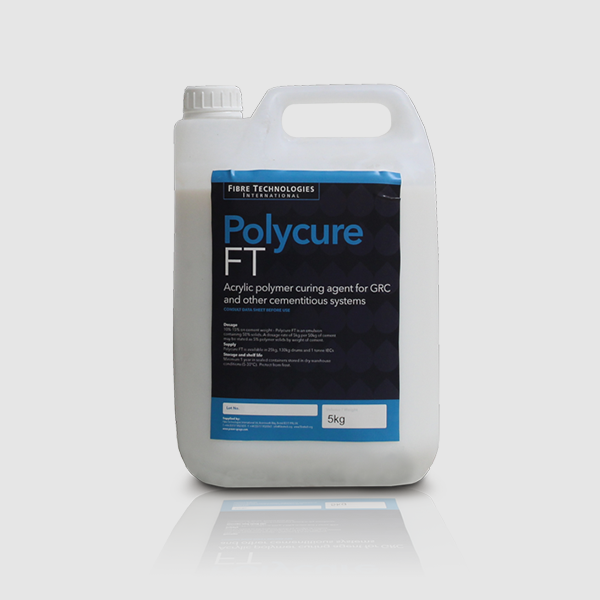
Polycure FT applies this proven all-acrylic polymer technology but has been specifically formulated for the high cement contents typically found in GRC. It supports efficient air-curing, consistent production, and the manufacture of durable GRC components with excellent long-term performance and high-quality architectural finishes.
The Benefits of Polymer-Modified GRC
Beyond improving the curing process itself, acrylic polymer technology delivers a range of practical performance benefits that have made polymer-modified GRC the preferred choice for manufacturers producing high-performance architectural and structural components.
Reduces Reliance on Traditional Wet Curing
Traditional GRC production required freshly cast components to remain under carefully controlled humidity conditions for up to seven days, allowing sufficient cement hydration to develop the required matrix strength. Acrylic polymer technology significantly reduces this dependency by enabling manufacturers to air cure components while maintaining the long-term performance expected from polymer-modified GRC.
For manufacturers producing large façade panels or high production volumes, this reduces the need for dedicated curing rooms, lowers handling requirements, improves factory throughput, and shortens production cycles without compromising the long-term mechanical properties of the finished composite.
Improves Long-Term Mechanical Performance
One of the greatest advantages of acrylic polymer modification is its ability to improve the long-term mechanical behaviour of GRC.
As conventional GRC ages, continued changes within the cement matrix gradually reduce flexural strain capacity, causing the composite to become increasingly brittle. Independent industry research has demonstrated that polymer-modified GRC retains significantly greater flexural strain capacity following years of natural weathering. By maintaining greater ductility, the material is better able to accommodate thermal movement, service loads and minor dimensional changes while resisting crack propagation throughout its service life.
This improved long-term performance makes acrylic polymer technology particularly valuable for components exposed to freeze-thaw cycles, moisture ingress, UV exposure and fluctuating temperatures.
Produces a Less Permeable Cement Matrix
Moisture movement is one of the principal causes of long-term deterioration within cement-based materials.
As the acrylic polymer coalesces within the hydrated cementitious matrix, it forms a continuous polymer network that reduces permeability and restricts the movement of water through the composite. Lower moisture absorption helps minimise the internal stresses associated with repeated wetting and drying cycles while improving resistance to weathering, freeze-thaw damage and environmental ageing.
The result is a GRC composite that remains cleaner, more dimensionally stable and better protected against long-term environmental exposure.
Improves Mix Cohesion and Sprayability
Beyond improving the hardened properties of GRC, all-acrylic polymer technology also enhances the fresh handling characteristics of the mix. During pumping and spraying, conventional GRC mixes can be susceptible to segregation, where water and fine cement separate from the aggregate. This can reduce mix consistency, increase the risk of blockages within spray equipment, and make application more difficult.
By improving cohesion and modifying the thixotropic behaviour of the slurry, acrylic polymer technology helps maintain a stable, homogeneous mix throughout pumping and spraying. The result is smoother material flow through equipment, improved build-up on vertical mould faces, and better retention on complex architectural profiles without excessive slump or sagging.
Improves Surface Finish and Colour Consistency
Architectural GRC is judged as much by its appearance as its structural performance.
All-acrylic polymer technology promotes more uniform pigment dispersion throughout the face mix, helping manufacturers achieve greater batch-to-batch colour consistency. It also produces a harder, more cohesive face mix that responds more consistently during finishing operations such as sandblasting while helping reduce surface crazing, microcracking and other cosmetic defects.
The result is cleaner architectural finishes, greater visual consistency across large production runs, and less remedial work after demoulding.
Reduces Drying Shrinkage and Surface Cracking
As cement cures, moisture gradually evaporates from the matrix, causing the material to shrink. If these shrinkage stresses exceed the tensile strength of the young composite, surface defects such as crazing, spider cracking and microcracking can begin to develop. Over time, these imperfections provide pathways for moisture ingress and accelerate long-term deterioration.
By forming a continuous polymer network throughout the hydrated cementitious matrix, acrylic polymers help reduce both drying shrinkage and reversible shrinkage by limiting moisture movement and relieving internal stresses within the composite. The result is improved dimensional stability, fewer surface defects, and greater long-term durability.
Supports a Wide Range of GRC Applications
The combination of improved curing efficiency, reduced permeability, enhanced dimensional stability and superior long-term durability has made polymer-modified GRC the preferred choice for a wide range of demanding applications, including:
- Architectural façade panels
- Heritage restoration projects
- Decorative mouldings and cornices
- Sculptural features
- Landscape and urban design elements
- Street furniture
- Infrastructure and civil engineering components
Whether reproducing intricate heritage details or manufacturing contemporary architectural façades, acrylic polymer technology enables manufacturers to produce lightweight GRC components with excellent long-term performance, weather resistance and consistently high-quality finishes.
Got a Question About GRC?
From production equipment to raw materials, we’ve got the knowledge and expertise to answer your GRC enquiry
Dosage Rates and Control
Unlike superplasticisers, which are typically dosed as a percentage of cementitious material to modify the fresh properties of the mix, all-acrylic polymer curing agents are dosed according to their polymer solids content. Dosage is generally expressed as polymer solids by weight of cement rather than the total quantity of liquid admixture added.
Industry guidance indicates that around 5% polymer solids by weight of cement is typically required to enable effective air curing. At this dosage, the polymer forms a continuous film throughout the hydrating cement matrix, helping to reduce moisture loss during curing while enhancing the long-term durability of the hardened composite.
The exact quantity of liquid polymer required will depend on the product’s polymer solids concentration, as different formulations contain varying proportions of water and active polymer. For this reason, manufacturers should always follow the supplier’s technical data sheet and confirm compatibility with their mix design, cement type, supplementary cementitious materials (where used), and production process before full-scale manufacture.
Polymer-Modified GRC in Practice

Shephard Hall, City College of New York
During the restoration of this historic building, GRC was used to replace the original light-coloured terracotta after decades of deterioration caused by freeze–thaw cycling and acid rain. The replacement system incorporated a polymer-modified face mix to maintain the as-demoulded architectural finish. Before selecting the system, the architect commissioned extensive ageing and weathering tests, with particular emphasis on resistance to acid rain, to verify the long-term durability and appearance of the polymer-modified GRC.
Conclusion
Acrylic polymer technology has transformed the manufacture of GRC by reducing reliance on traditional wet-curing regimes while enhancing long-term durability, moisture resistance, dimensional stability and surface quality. As a result, polymer-modified GRC has become the industry standard for a wide range of demanding architectural, restoration and structural applications where long-term performance is critical.
While acrylic polymer technology is well established, achieving consistent results depends on selecting a polymer system specifically formulated for the high cement contents and demanding production conditions associated with GRC manufacture.
Polycure FT is Fibre Technologies’ all-acrylic polymer curing agent, developed specifically for GRC. Engineered to support efficient air curing, improve long-term durability and produce high-quality architectural finishes, it provides manufacturers with a reliable solution for modern polymer-modified GRC production.
To learn more about Polycure FT, request a technical data sheet, or discuss your GRC production requirements, get in touch with our associate company, Fibre Technologies’ team today: info@fibretech.org or view specific details and order online at: Fibre Technologies – Polycure FT