How is Glassfibre Reinforced Concrete Making Modular Construction Even More Efficient?
With an increasing emphasis on speed and efficiency of construction, modular construction is a practice that has seen a rise in recent years. This process involves producing prefabricated components (or ‘modules’) off-site under controlled factory conditions before being transported to the site for speedy assembly.
By following this methodology, construction time and labour costs can be significantly reduced whilst also reducing wastage through consistent quality checks which may be absent when producing panels on-site where defects or poor-quality components are prevalent.
To further increase the efficiency of this already expeditious process, modular construction specialists are utilising Glassfibre Reinforced Concrete (GRC / GFRC) to produce components.
Read on to learn about the 5 qualities that make GRC and modular construction the perfect pairing.
The 5 Qualities
The qualities of GRC are demonstrated to great effect in modular construction, which is why it is becoming so widely used to create prefabricated components. These qualities include:
- Incredible light weight
- Remarkable strength
- Accurate mimicking of textures
- Environmentally friendly
- Exceptional thermal performance
Let’s explore why this range of versatile and unique properties make GRC perfectly suited to satisfy the requirements of modular construction projects…

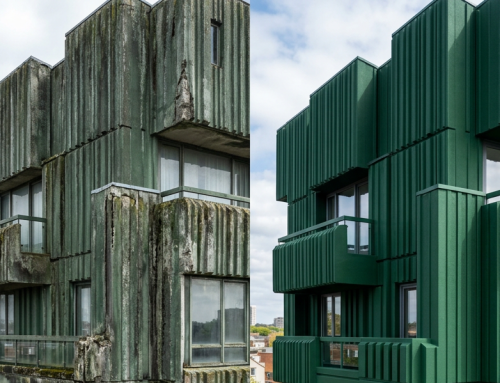
Photo Credit: BB fiberbeton
Lightweight Nature
One of GRC’s hallmark features is its incredibly lightweight nature. When producing GRC panels, manufacturers can expect to achieve weights up to 80% lighter than its precast concrete equivalent.
For instance, a cladding panel made from 100mm thick precast concrete would weigh 240kgs per m², while a similar GRC panel typically weighs only 40-50kgs per m².
This reduction in weight makes for simple and easy transportation of building components and offers a far more convenient and less labour-intensive installation on-site. Moreover, many GRC products can be easily lifted and carried by hand: a crucial aspect given the stringent manual handling regulations in numerous countries.
Components can be efficiently assembled using rivets to mount the cladding panels whilst supports are attached directly to the front wall using bolts or anchors. Thanks to the reduced load of the GRC panels on buildings, significant savings can be made in superstructure and foundations.
The inherent strength of the material further enhances the lightweight properties of GRC components. Its strength allows for GRC to be manufactured using thin-wall casting techniques and, with these hollow profiles, weight can be reduced even more. These thin panels expedite concrete setting times and ultimately facilitate a faster construction pace.

Superior Strength
The lightweight nature and unparalleled mechanical strength of GRC prove to be a perfect pairing when it comes to modular construction.
The exceptional strength of GRC far surpasses that of traditional concrete whilst negating the need for excessive cement content thanks to the AR Glass Fibres at the core of the composite. These fibres can yield results with a 30% greater tensile strength than steel, a testament to GRC’s superior performance in demanding structural applications.
GRC’s reinforced matrix offers enhanced durability and longevity, ensuring structural stability and resilience across all modular components over time. In the rare cases where do faults do occur over the product’s lifespan, the modular nature of the panels allows for components to be easily removed and replaced.
Got a Question About GRC?
From production equipment to raw materials, we’ve got the knowledge and expertise to answer your GRC enquiry
Textured Finishes
GRC’s malleable properties allow it to effortlessly assume intricate forms and designs and can even replicate the organic textures of natural elements.
This versatile asset in GRC’s arsenal of properties allows for panels to be produced that mimic the various surface textures, finishes, and colours of far inferior materials but attain the exceptional mechanical properties of GRC.
Whether a modular construction specialist is looking to replicate the appearance of brickwork, natural stone, or wood, GRC can imitate these materials to a high degree of accuracy to a point where it’s almost impossible to determine which is which.

Environmentally Friendly
GRC is considered by many to be a ‘green’ material thanks to its resource-efficient production process, enhanced product lifespans, and extraordinary insulative properties. When using the material in modular construction, manufacturers can greatly benefit from these qualities.
By prefabricating components off-site, manufacturers can implement consistent quality control checks, reducing the risk of faulty panels being produced and minimising wastage. Moreover, the lighter GRC panels require far fewer fixings and a lighter supporting structure, further improving material efficiency.
The superior quality of GRC panels translates directly into improved longevity. GRC components are far less likely to require repairs or to be replaced over the product’s lifespan with life-cycle assessments revealing that GRC production has a far lower environmental impact of as high as 60% in comparison with its traditional concrete counterpart.

Thermal Performance
As mentioned, GRC’s extraordinary ability in enhancing building insulation and energy efficiency is another aspect of the material’s green credentials. Modular construction specialists can utilise this characteristic of GRC to great effect.
By incorporating specialised additives and insulating materials into its matrix, GRC effectively reduces thermal conductivity and minimises heat transfer through building envelopes. This insulation enhancement capability translates into reduced energy consumption for heating and cooling, resulting in lower operational costs and reduced carbon emissions over the building’s lifecycle.

A Perfect Pairing
GRC and modular construction are simply a perfect pairing. The unique and versatile set of mechanical properties that GRC possesses greatly lends itself to the methodology of modular construction.
From reduced material wastage to expedited construction times, the benefits are numerous and it’s clear why modular construction specialists are turning to GRC to improve their practices.
Power-Sprays can supply all the equipment you need to produce GRC modules that can be used to efficiently erect modular structures. To view our product range click here or if you want to learn more about the services we offer, get in touch today.