Photo Credit: Laura Paredis
GRC Project Case Study
Kilden Performing Arts Centre
Kristiansand, Norway
GRC Project Case Study
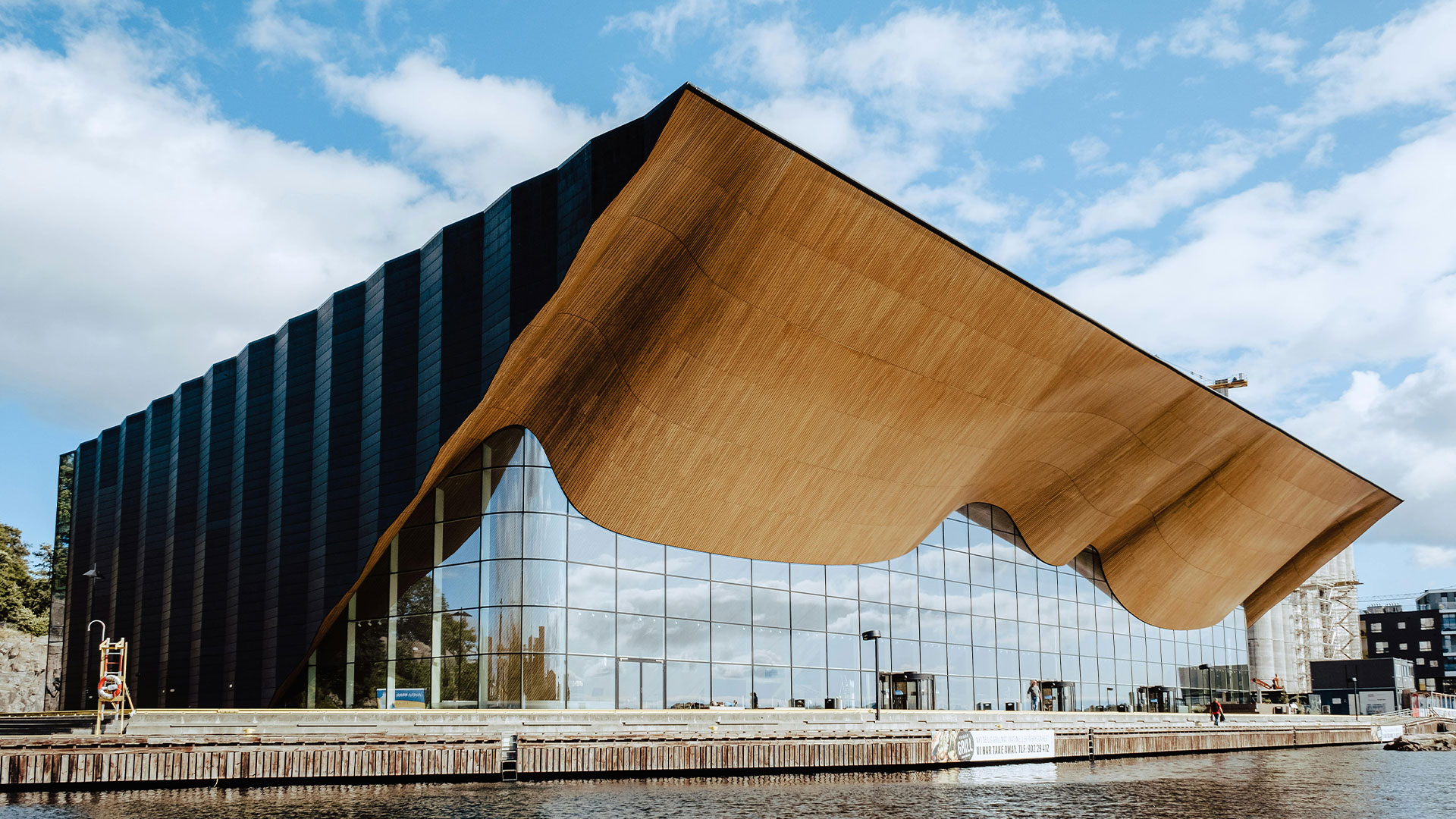
Facing out towards the Nordic Sea, the undulating main façade of the Kilden Performing Arts Centre is reflected in the rippling waterfront of the harbour on Odderøya Island, Kristiansand. Contrasting with its urban, industrialist surroundings, its naturalistic form is clad with locally sourced oak, forming a division between reality and the fantasy of performance as the façade continues through the glazed front into the interior foyer, emphasising the inviting character of the open space.
This magnificent structure embodies a subdued elegance: a physical characterisation of the performing arts facilities that it houses. Within the walls of rhythmic, vertically folded dark metal sheet facades, flowing oak cladding and sheer glass, is the Agder Theatre, Kristiansand Symphony Orchestra (KSO) and Opera Sør – a conglomerate of the Sørlandet region’s performing arts institutions.
Construction began in 2007, following an architectural design competition held in 2004-2005 where 96 architectural firms submitted their proposals for the buildings design. It was Finnish company ALA Architects who won the competition with their elegant and abstract design of the centre.
Acoustic Performance
The Kilden Performing Arts Centre encompasses a total area of 16,500 square metres, housing a concert hall with almost 1,200 seats, a theatre and opera stage with roughly 750 seats, a multi-purpose hall with 400 standing places and a hall for smaller events.
Naturally, the building required optimal acoustics to enhance the auditory experience of each performance. Brekke & Strand were called in as an acoustic consultant for the project, with Arup being responsible for the acoustic design of the concert hall.
Initially, precast concrete was selected to form the internal acoustic panels which would be manufactured with distribution and reinforcing steel work cast into the elements for later installation. Originally, this appeared to be a viable solution, however this approach raised several technical and operational issues which led to the exploration of more appropriate materials.
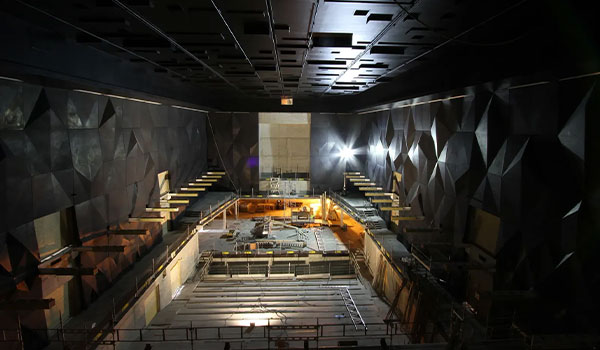
Photo Credit: Byggimpuls
Installing GRC
Offering a level of precision, functionality and quality that precast simply couldn’t match, the decision was ultimately made to manufacture the acoustic panels using Glassfibre Reinforced Concrete (GRC). Byggimpuls were responsible for the design, manufacture and installation of these elements.
By using GRC as opposed to precast concrete, the weight of the units were reduced by 50% or more which made it possible to use the on-site cantilever crane facilities to handle lifting and installation, negating any requirement for a large mobile crane. Moreover, the panel and fixing solution devised by Byggimpuls allowed for easier micro-positioning of the 142 GRC elements onto the supporting framework, expediting the installation time and aligning with the overall project timeframe.
The surface geometry of the acoustic panels was extremely complex, and the finished concrete required exceptional precision and outstanding quality – a challenge effortlessly met by GRC which consists of an incredibly compact and dense matrix, capable of achieving immaculate finishes. Additionally, the GRC elements could be through-coloured to achieve the desired black tone outlined by the designers.
Got a Question About GRC?
From production equipment to raw materials, we’ve got the knowledge and expertise to answer your GRC enquiry
Conclusion
In the context of the performing arts, the architectural symphony of the Kilden Performing Arts Centre is composed like an orchestra. Whilst the bold silhouette and dramatic form of the structure steals the spotlight – representing the soloists of the ensemble – it is the subtly strong, precise and versatile notes of the GRC elements that endow the composition its depth and coherence: a profound, reverberating bass.
Metaphors and analogies aside, Glassfibre Reinforced Concrete proved an invaluable asset to the design team of the Centre that went far beyond its base purpose of acoustic performance. While the composite offers inherent acoustic properties, its versatile characteristics of aesthetic malleability, structural durability and lightweight nature further emphasise the material as a solution to a wide range of construction challenges.
There’s far more to GRC than meets the eye. If you’re interested in learning more, visit the GRC Guide on our website or get in touch.
If you’re looking for the specialist equipment and materials required to produce this remarkable composite, you’ve come to the right place. Explore our range below or send us an email for more information.