[Image: Courtesy of FDOT]
FRP Rebars Project Case Study
Halls River Road Bridge
Florida, USA
At a Glance
- Replacement of a 56.7 m vehicular bridge in Homosassa, Florida
- FRP rebars incorporated into the bridge deck, barriers and approach slabs
- Project designed for a saltwater, chloride-rich environment where corrosion resistance was a key requirement
- Lightweight materials supported faster transportation and accelerated construction
- Targeted service life of 75+ years with minimal maintenance requirements due to high strength and fatigue endurance
Project Overview
The replacement of the 56.7 m vehicular Halls River Bridge in Homosassa, Florida, was developed by the Florida Department of Transportation (FDOT) as a premier national demonstration project for advanced technology and materials in civil infrastructure. Designed by FDOT District Seven Structures Staff with the assistance of Assistant State Structures Design Engineer, the construction phase was successfully executed by lead contractor Watson Civil Construction Inc. to replace a previous structure that had become functionally obsolete from severe environmental deterioration.
Located in a coastal environment exposed to intense humidity, salinity, and chloride-rich conditions, the FDOT sought a solution capable of improving long-term durability while drastically reducing future maintenance requirements. Traditional steel reinforcement systems are highly susceptible to corrosion in these environments, creating massive lifecycle challenges for bridge owners responsible for long-term asset management.
To validate the field performance of the non-corrosive materials, FDOT partnered with the University of Miami’s Department of Civil and Architectural Engineering – to conduct long-term material monitoring and durability testing.
The Role of FRP Rebar
FRP rebar was integrated into several critical concrete elements across the bridge project, including the bridge deck, barriers, bent caps, and approach slabs. Additional Fibre-Reinforced Polymer (FRP) technologies, such as Carbon Fibre Composite Cables (CFCC) and Hybrid Composite Beams (HCB), were incorporated into structural elements to create a comprehensive corrosion-free system.
Concrete performs exceptionally well in compression but requires internal reinforcement to accommodate tensile forces. Steel reinforcement has traditionally fulfilled this role; however, exposure to chlorides and moisture can result in catastrophic corrosion over time. The use of FRP reinforcement provided a completely non-corrosive alternative capable of maintaining structural performance while eliminating the primary deterioration mechanisms associated with reinforced concrete infrastructure.
The upgraded structure incorporated:
• #4 FRP rebars (12.7 mm diameter) – Tensile strength: 758 MPa and Elastic Modulus: 46 GPa
• #5 FRP rebars (15.9 mm diameter) – Tensile strength: 724 MPa and Elastic Modulus: 46 GPa
• #6 FRP rebars (19.1 mm diameter) – Tensile strength: 690 MPa and Elastic Modulus: 46 GPa
• #8 FRP rebars (25.4 mm diameter) – Tensile strength: 720 MPa and Elastic Modulus: 46 GPa

[Image: Courtesy of FDOT]
Added to cover 985 m², these component specifications allowed for optimised, prefabricated bar layouts that streamlined on-site assembly and significantly reduced structural cage weight.
Got a Question About GRC?
From production equipment to raw materials, we’ve got the knowledge and expertise to answer your GRC enquiry
Sustainability and Performance Outcomes
The material strategy adopted within the Halls River Bridge project focused heavily on durability and lifecycle performance. The use of FRP rebar contributed to:
- Elimination of chloride-induced corrosion within reinforced elements
- Lower anticipated maintenance requirements over the bridge lifecycle
- Increased durability in aggressive, high-salinity environmental conditions
- Improved long-term infrastructure resilience against sea-level and humidity exposure
Project teams identified corrosion resistance and reduced lifecycle intervention as the key parameters driving the wider bridge design approach.
“We want to make structures durable and sustainable. In some instances, steel is marvellous. But corrosion is something we cannot resolve [with steel reinforcements] when a structure is exposed to chlorides like seawater or de-icing salts. Composites serve the purpose where corrosion is a problem.” — Antonio Nanni, Professor and Chair of the Department of Civil and Architectural Engineering at the University of Miami
Why FRP Rebar Was Suitable
FRP rebar was selected due to several material characteristics that aligned perfectly with the project’s environmental and performance requirements:
- 100% corrosion resistance in chloride and saltwater environments
- Lower cost than traditional steel
- High strength-to-weight characteristics supporting efficient transportation, lighter cages, and safer handling and reduced construction time
- Drastically reduced deterioration risk compared with conventional steel reinforcement
- Extended service life (75+ years) for infrastructure exposed to aggressive environmental conditions
For bridge applications operating in high-moisture and high-salinity environments, these characteristics can support longer service life and reduced intervention requirements.
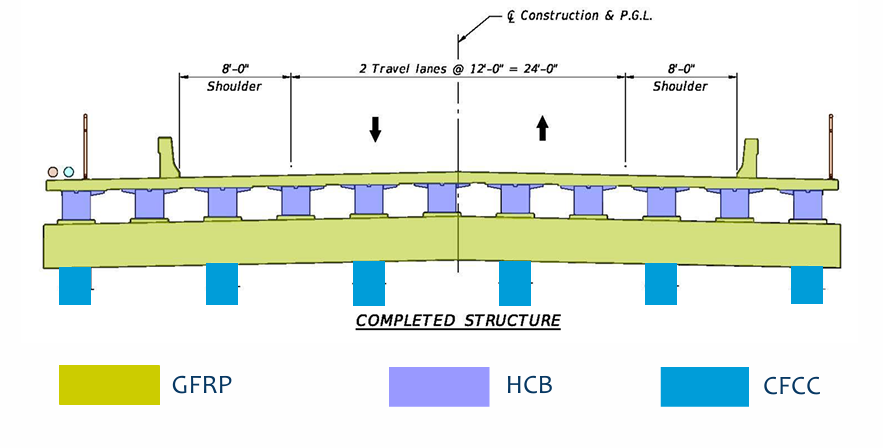
[Drawing: Courtesy of FDOT]
Conclusion
The Halls River Road Bridge serves as a definitive case study demonstrating how FRP rebars can support durable concrete infrastructure in aggressive environments where corrosion presents a significant challenge.
By integrating FRP rebars into critical structural elements, the project highlighted how alternative reinforcement systems can contribute to long-term durability strategies, supporting modern infrastructure designed for improved resilience and minimal maintenance.
If this sounds like the ideal material for your next project, get in touch with our associate company, Fibre Technologies International: they hold large stocks of FRP Rebar, available in a range of sizes.