Photo Credit: Fatih Turan
GRC Project Case Study
Yavuz Sultan Selim Bridge
Istanbul, Turkey
GRC Project Case Study
Stretching 2,164 metres over the mighty Bosphorus strait from Garipçe to Poyrazköy, the Yavuz Sultan Selim bridge acts as a vital connection between Europe and Asia. By housing both an eight-lane motorway and two high-speed railway lines, the bridge boosts highway capacity and eases congestion on the existing crossings over this strategic waterway.
Aesthetically, the bridge is a phenomenon of contemporary architecture: its striking A-shaped towers soaring 332 metres above the landscape, with a sweeping cable system draped across the bridge’s span. From a sculptural engineering perspective, however, it’s even more impressive.
The Bosphorus is an area of outstanding tranquil beauty, consisting of dense forests and rocky coastline, yet is also an area prone to turbulent climatic conditions, including powerful currents and high winds. Compounding the challenging climatic conditions of the area was the project’s short time-frame of just 36 months, which presented further obstacles for Michel Virlogeux and Jean-François Klein who led the design of the strait’s latest crossing.
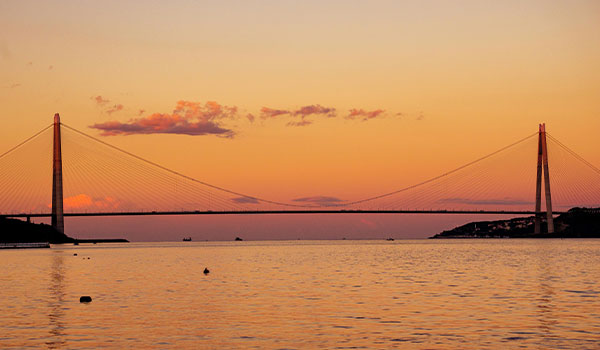
Photo Credit: Cihan Osman Tunceli
Vision & Overview
A traditional suspension bridge design was selected to align with the aesthetics of the Bosphorus strait’s two other bridges and to resist the stresses of Bosphorus’ high winds. To further provide stability and stiffen the bridge, a hybrid approach of combining super-long, high-strength cables and a ‘catenary’ suspension cable was implemented.
These cables were hung between two immense A-shaped pylons which stand at 332 metres tall – a fact which, at the time of completion in 2016, made the Yavuz Sultan Selim bridge the tallest suspension bridge in the world. These pylons are likely the most eye-catching aspect of the design, forming a gateway from one continent to the next, piercing the skyline with angular, tapered crowns, lending the bridge its iconic silhouette.
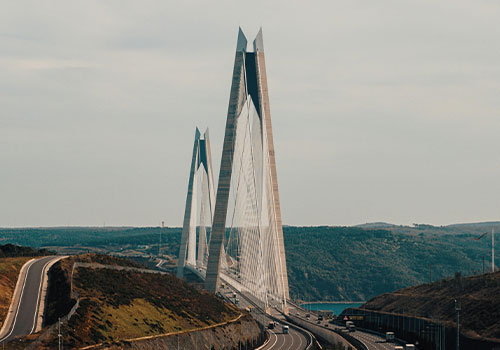
Photo Credit: Abdullah Al Mallah
GRC Cladding
The peaks of these towers – between 297 and 322 metres – were clad with 3,500m² of thin, lightweight and durable Glassfibre Reinforced Concrete panels produced by GRC manufacturer Fibrobeton. This 25 metre section would be exposed to wind loads of up to 300kg/m², requiring an innovative approach in designing the panels.
Fibrobeton’s solution was to develop a special high-performance GRC (HPGRC). This HPGRC was shaped into ribbed panels – incorporating a hybrid reinforcement of glass and carbon mats – which demonstrated wind resistance without compromising on increased weight. Fibrobeton were able to form remarkably slender yet strong profiles using this special mix design, achieving panel thickness of just 30mm with dimensions of 3.0 x 4.5m. Before installation, the panels underwent rigorous testing to determine fatigue behaviour under constant high wind loads.
Not only did the panels meet wind-resistance requirements, but the steel-free composition of GRC meant they were also non-corrosive and met the product durability goal of 100 years.
Got a Question About GRC?
From production equipment to raw materials, we’ve got the knowledge and expertise to answer your GRC enquiry
Conclusion
By using GRC, the designers found resolutions for both the structural demands of the bridge as well as the short time-frame of the project.
The pinnacle of the towers was initially intended to be clad in precast concrete which would have weighed 350kg/m², however GRC was ultimately selected due to its comparative weight of just 110kgm/². Moreover, the cladding’s reduced weight resulted in the main load bearing steel structure’s weight dropping from 350 to 160 tonnes.
These GRC panels were attached to pre-assembled steel modules on the ground which reduced assembly time to just 20 days – an invaluable achievement considering the overall project time-frame of only 36 months.
Once again, GRC demonstrates itself as an indispensable solution for myriad challenges in architecture, engineering and construction. But do you know where the world’s leading GRC manufacturers get the equipment and materials they need to execute projects like this? That would be us.
Get in touch or visit the Power-Sprays or Fibre Technologies websites to find out more on how we can assist your GRC production process.