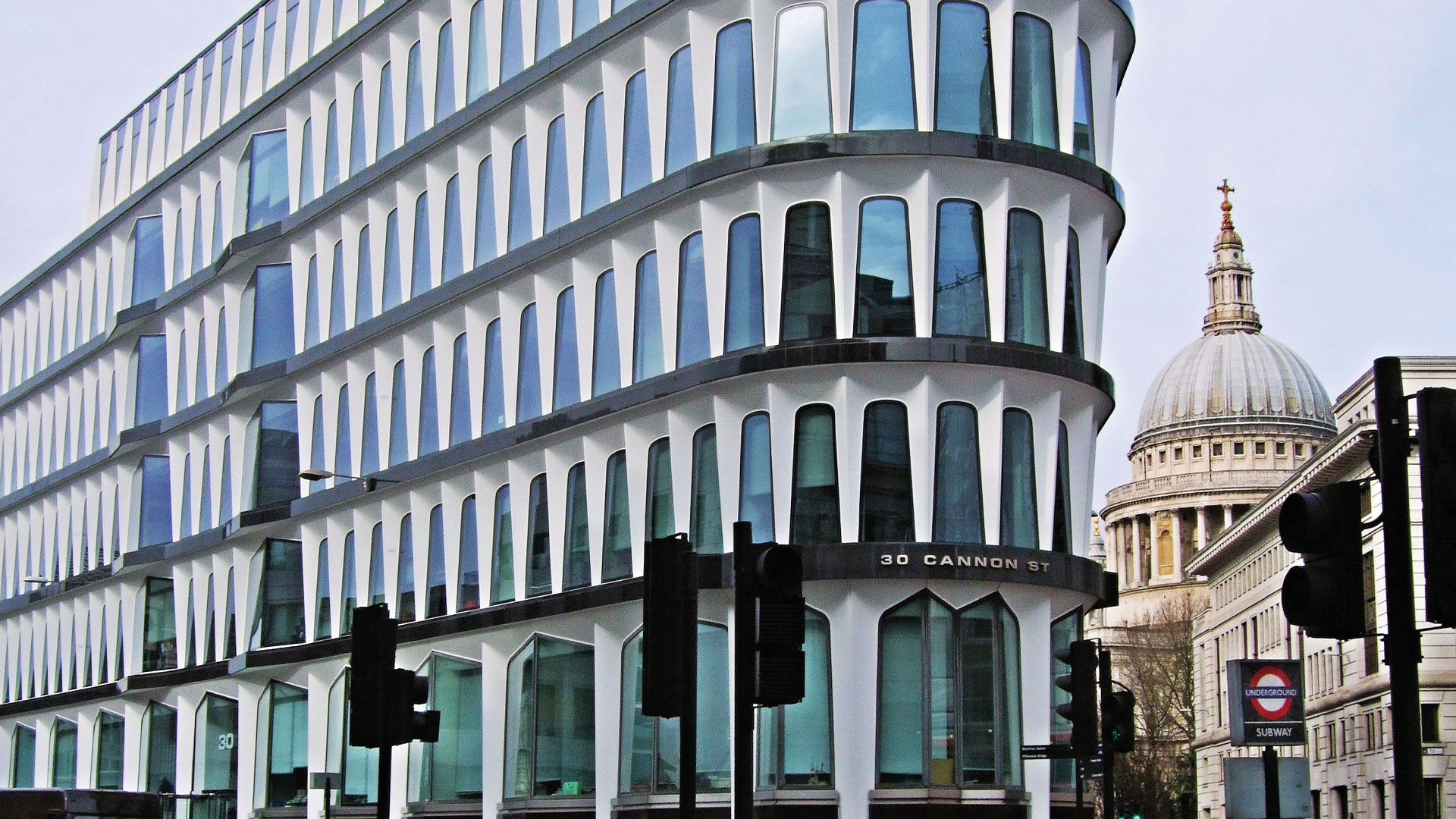
30 Cannon Street
London, UK
GRC Project Case Study
GRC Project Case Study
30 Cannon Street is a landmark achievement in architectural Glassfibre Reinforced Concrete (GRC) applications.
This incredibly unique building occupies a prominent wedge-shaped site in the core of the City of London. Located near St Paul’s Cathedral on the junction of Cannon Street and Queen Victoria Street, this office building was designed and constructed from 1974 to 1977 by Whinney Son & Austen Hall to act as the London Headquarters of Crédit Lyonnais.
No expense was spared on the building, which was to command the island site and be recognisable at a distance. Many choices of cladding were considered yet ultimately rejected before finally settling on the use of Glassfibre Reinforced Concrete (GRC / GFRC).

The First of Its Kind
The GRC units used were cheaper, lighter, thinner, and less porous than pre-cast concrete equivalents, thus reducing the costs of the structure, foundations, and transport. Moreover, the slim nature of the panels meant that valuable extra square metres of central London office space were gained.
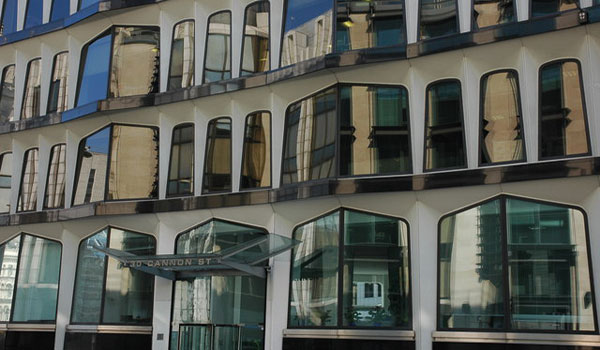
Some 1,900 double-skin GRC panels were produced for the structure and delivered to the site complete with window frames, leaving only the glass to be fitted in-situ. Once fitted, these cream hollow-section GRC panels offered a curved facade of arches sloping outwards with deep angular reveals that form a striking structure.
Being the first building in the UK to be clad entirely in double-skinned panels of GRC, this project has since become a point of reference for manufacturers and facade specialists.
A Landmark Achievement
In 2015, 30 Cannon Street was granted Grade II Listed status due to its strong stylistic and functional affinities with the Victorian commercial architecture of Queen Victoria Street.
Later, when needs arose for re-development of the building with the intention of creating a new rooftop terrace, the need to preserve the architectural integrity of the building remained equally as important as the need to enhance the structure.
The facade was extended using GRC profiles that matched the geometry, materiality, and colour of the existing GRC cladding panels – further demonstrating the aesthetic versatility of the material.
Today, it stands as a landmark building whose historic importance is recognised globally, particularly by those in the GRC industry.
Got a Question About GRC?
From production equipment to raw materials, we’ve got the knowledge and expertise to answer your GRC enquiry
GRC Innovators
Much like 30 Cannon Street, Power-Sprays is an example of innovation in the GRC field. Having been involved in the Glassfibre Reinforced Concrete industry for 50+ years, we’ve gained a level of experience working with the material that can be matched by no-one else.
This experience is directly translated into our range of specialist GRC production equipment and materials – all specially engineered to proactively meet the niche requirements of GRC production.
View our range online or if you have any enquiries, reach out and our expert team will be on hand to help: